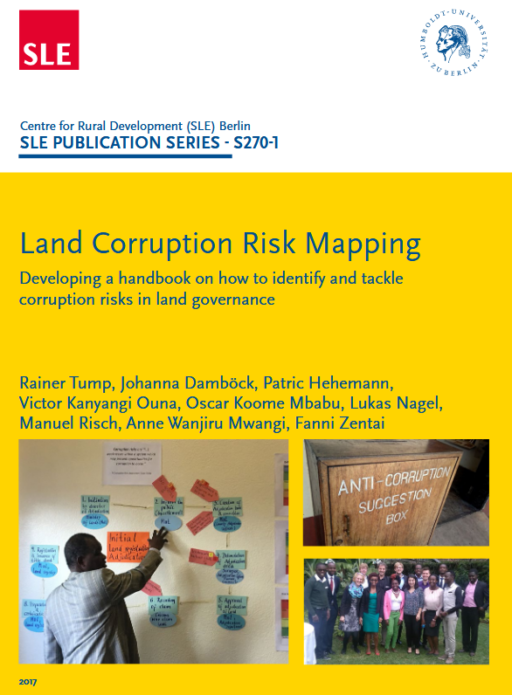
The Handbook on Land Corruption Risk Mapping is a practical tool designed to identify and assess corruption risks in land governance, and to support the development of effective countermeasures. Commissioned by Transparency International and developed by the Centre for Rural Development at Humboldt-Universität zu Berlin (SLE), the handbook was first produced in Phase I of the Land and Corruption in Africa project and continues to be used in Phase II.
The tool guides users through three key phases: from research and evidence gathering, to a participatory, multi-stakeholder risk-mapping workshop, and finally, to strategy development. Within these phases, nine structured steps combine data, expert input, and local knowledge to build a shared understanding of risks and possible responses. Grounded in real-world contexts — including some case studies from Kenya — the handbook provides both methodological guidance and practical insights.
The handbook is designed primarily for use by Transparency International chapters, but can equally support civil society organisations, public institutions, and policymakers. Its participatory approach ensures that diverse voices, particularly those of vulnerable and marginalised groups, are included in shaping fairer, more transparent land systems.
Authors
Rainer Tump, Johanna Damböck, Patric Hehemann, Victor Kanyangi Ouna, Oscar Koome Mbabu, Lukas Nagel, Manuel Risch, Anne Wanjiru Mwangi, Fanni Zentai
 Download PDF
